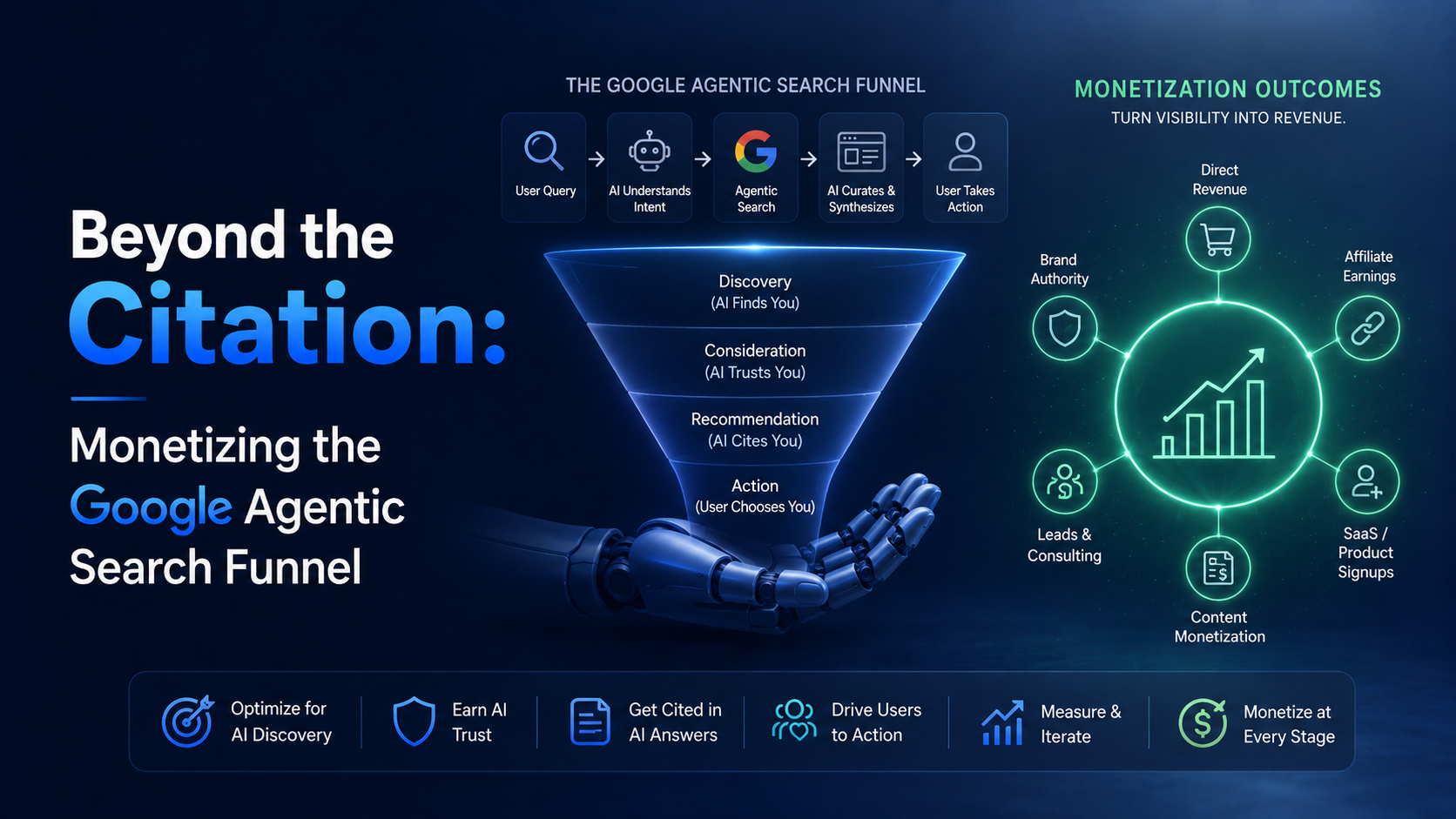
In our previous playbook, How to Adapt to Google's Agentic AI Search, we broke down the necessity of turning your content into a clean data infrastructure. We explored how structured schema architecture ensures your brand is indexed and cited by the leading LLMs.
But once your technical data is readable by a machine, a multi-million dollar question remains: How do you actually capture revenue when the AI agent refuses to send traffic to your website?
The announcements at Google I/O 2026 made it undeniable that Google's ecosystem is evolving into a full-funnel transaction layer. Users aren't just looking up information in Google AI Mode — they are letting background agents book flights, plan events, and purchase items using an embedded Universal Cart.
If your marketing strategy relies entirely on winning a tiny hyperlink citation, you are missing the point. Here is how to position your brand to monetize the zero-click, agent-driven economy.
Pivot from SEO Rankings to "Agent Commerce" API Readiness
In an agentic ecosystem, traditional Search Engine Optimization (SEO) positions matter far less than system interoperability. An AI agent doesn't read the text on your site to hand-deliver a visitor — it crawls your ecosystem to take an immediate action on a user's behalf.
The businesses thriving right now are the ones building "agent-friendly" data gates. The structural difference is stark:
[Traditional Search] ──> User reads 10 blue links
──> Clicks link
──> Converts on site
[Agentic Commerce] ──> AI Agent reads your API
──> Autocomplete
──> Zero-click transaction
To secure a piece of this action, your tech stack must provide clear, machine-readable developer paths. Here are the three non-negotiable implementations:
Expose Public API Endpoints
Cleanly document your /api/products or /api/bookings schemas so autonomous agents can dynamically query your live pricing and stock without needing to render a page.
Implement Universal Cart Schema
Optimize your data feeds for Google Merchant Center to allow the AI to process transactions without redirecting the browser. This is the primary integration layer for zero-click commerce.
Hardcode Execution Triggers
Ensure actions like OrderAction and ReserveAction are deeply nested in your technical schema markup. Agents scan for executable action types, not just informational content.
Capture Long-Tail Voice Queries via Contextual Clusters
The average query inside Google's conversational AI interfaces has grown two to three times longer than a classic keyword string. Users no longer type "best project management tool". Instead, they voice-prompt complex, constraint-heavy requirements:
To win these highly profitable, hyper-specific conversions, your content team must stop publishing generic, surface-level articles. As detailed in our piece on adapting to Google's Agentic AI Search, the architecture of your content is now as important as the content itself.
The Strategy: High-Density Content Fragments
Using structured data and semantic markup, you must design your web pages using localized markdown tables and tightly scoped text blocks. Keep your context windows tight. Give immediate answers in the first sentence of your paragraphs.
When Google's specialized reasoning agent parses your page, it should be able to pull an exact data matrix that answers every hyper-nuanced user constraint — without wading through marketing filler.
Lead with the answer, not the context
Agents parse the first 1–2 sentences of each paragraph. If your answer is buried in paragraph three, it won't be selected. Restructure every section to front-load the actionable data point.
Use semantic tables for comparative data
Pricing tiers, feature comparisons, spec sheets — all of these are prime candidates for machine extraction. A well-structured HTML table is far more likely to be injected directly into an AI response than a paragraph description of the same data.
Map content to constraint-types
For every key product or service, build a dedicated page addressing specific constraint clusters: industry, team size, integration compatibility, compliance requirement. Each one captures a distinct long-tail agentic query pattern.
Redefine Your Conversational KPIs
If clicks are dropping, your internal marketing dashboards must change. Measuring web traffic to calculate digital ROI is a framework built for a previous decade. The metrics that matter in the agentic era are fundamentally different — and most organisations are still tracking the wrong ones.
| Legacy Metric | Agentic Marketing Success Metric |
|---|---|
| Organic Click-Through Rate (CTR) | Brand Mention Share (BMS) How frequently your brand is selected as the top choice within LLM responses — across Google AI Mode, ChatGPT, Perplexity, and others. |
| On-Page Time / Session Duration | API Action Conversion Rate Transactions triggered entirely within Google's native AI interface via your Merchant Center or API integrations — zero browser redirects. |
| Keyword Ranking Position | E-E-A-T Sentiment Score Your overall authority score across trusted third-party networks, publisher hubs, and forums — the signals agents use to determine citation worthiness. |
This shift in measurement also has implications for how you allocate paid media spend. Channels and bid strategies optimised purely for last-click attribution will undervalue agentic touchpoints where the AI referenced your brand but the transaction happened inside the agent interface.
Moving Forward: From Ambiguity to Certainty
Winning the agentic era requires accepting that your site is no longer the final destination. It is a data repository designed to feed autonomous machines.
By prioritizing action-oriented schema, optimizing for complex spoken-language queries, and shifting your metrics to focus on Brand Mention Share, you ensure your organisation dominates the new full-funnel search landscape — not just as a citation, but as the brand agents choose to transact with.
The organisations that treat the zero-click era as a threat will watch revenue erode. The ones that treat it as a structural redesign opportunity — rebuilding their data layer, their content architecture, and their measurement framework — will own the category.
For a deeper look at how this dynamic plays out inside the paid media stack, read our full breakdown of Google Ads in the Agentic AI Era. And to understand the long game — how to build an audience that no algorithm can mediate away — start with The Synthetic Chokehold.