If you thought organic search took a hit with the rise of zero-click answers, look closely at your paid acquisition channels.
At the latest Google Marketing Live event, Google dropped a definitive roadmap for how advertising operates when users stop browsing and start delegating. As outlined in Google's Official Ads Update, advertising is transforming from "matching keywords to headlines" to "embedding solutions directly inside AI-driven multi-step workflows."
Organic readiness is only half the battle. When Google's AI agent acts as a personal assistant, researcher, and concierge all at once, paid media becomes the primary vehicle to cut through the synthetic noise.
Here is everything you need to know about navigating, budgeting, and scaling Google Ads in the age of agentic search.
The Death of the "Ad Slot": Welcome to Generative Ad Injection
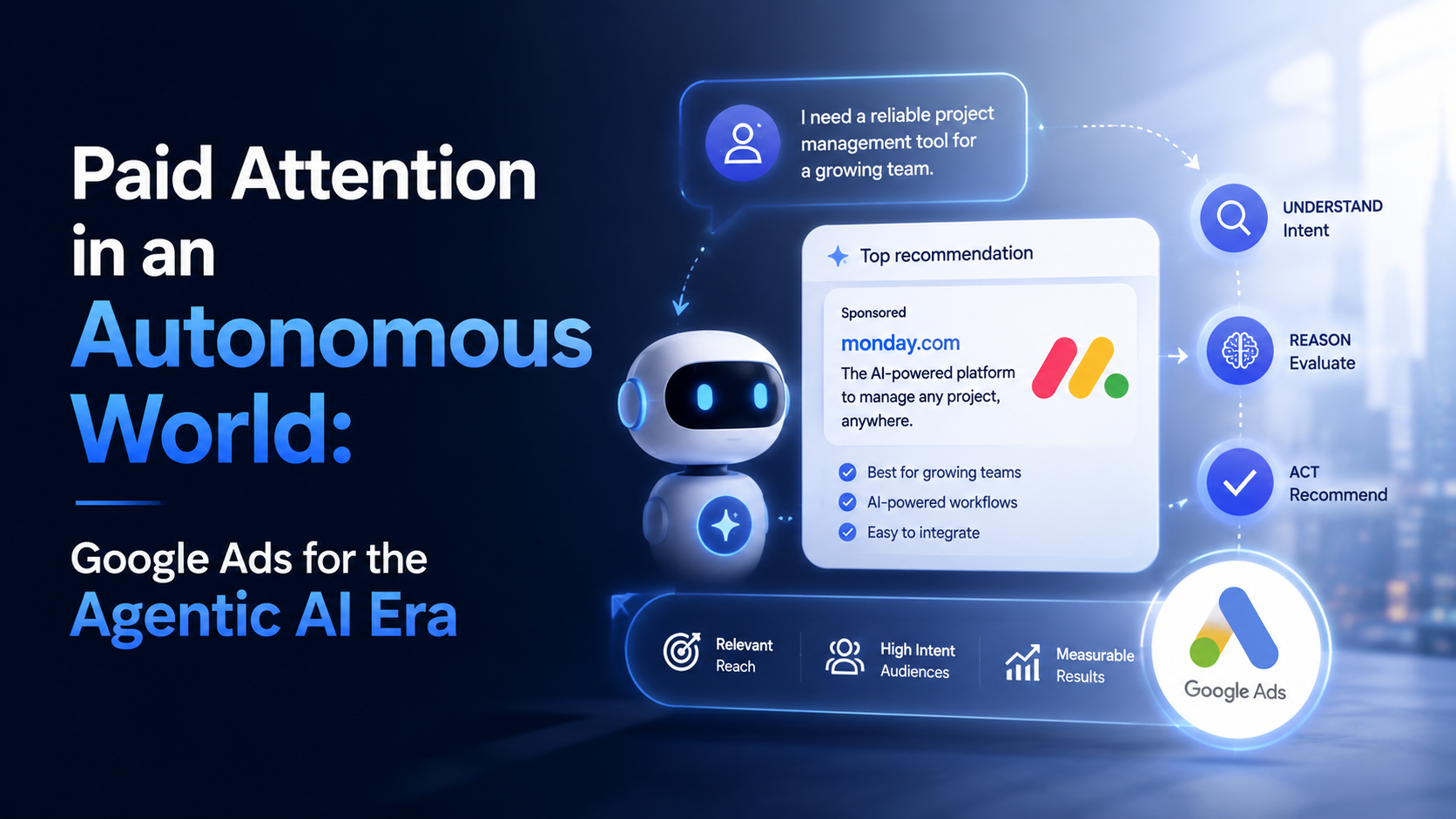
For decades, Google Ads lived safely at the top, bottom, or side of a clean results list. In the agentic era, static ad slots are disappearing. Instead, ads are dynamically synthesized and injected natively inside the AI's conversational reasoning and action path.
Instead of displaying a standard text ad for "Best CRM Software," Google's AI engine evaluates commercial options while executing a complex user prompt.
What This Looks Like in Practice
If a user tells Google, "Plan a 5-day corporate retreat in Austin for 15 people under $10,000, and find an event space with AV equipment," the agent handles the logistics. Google doesn't just show a list of venues — it builds an itinerary. Sponsored event spaces are seamlessly stitched in as recommended, pre-vetted options that match the specific budget constraints.
From Search Terms to Conversational Context
The traditional search term report is losing its granularity. As search behavior shifts toward natural language, long-form logic, and multi-turn audio interactions, keywords are being replaced by Deep Intent Signals.
The Solution: Lean into Broad Match + Smart Bidding + Assets
Many legacy media buyers still resist Broad Match, but in an agentic ecosystem, exact keywords are too rigid. Google's agentic search relies heavily on understanding user intent. To win here, your focus must shift toward Asset Excellence:
Dynamic Conversational Assets
Ensure your ad variations include conversational, solution-oriented headlines that can be mixed and matched by Google's AI to answer multi-layered user prompts.
Profit-Driven Smart Bidding
Because traffic volume may fluctuate as zero-click interactions scale, optimize for Value-Based Bidding (VBB) or Target ROAS rather than raw clicks. Train Google's algorithm to find high-intent agents ready to convert.
PMAX and Performance Max for AI Agents
Performance Max (PMax) has evolved from an optional automated campaign type into the foundational framework for agentic advertising. Google's AI needs complete access to your entire digital asset inventory — YouTube, Display, Search, Discover, Maps, and Gmail — to find the user wherever the agent is interacting on their behalf.
The Agentic PMax Checklist
Impeccable Merchant Center & Product Feeds
Just as structured metadata is critical for organic AI citations, your paid product feeds must be flawlessly structured. High-resolution images, exact attribute data, and real-time inventory levels are non-negotiable.
First-Party Data Integration (Conversion 360)
Because agentic systems operate behind a layer of synthetic synthesis, tracking attribution is harder than ever. Feed your first-party CRM data directly into Google Ads via Enhanced Conversions and offline conversion tracking — this tells the AI exactly which agentic interactions resulted in real revenue.
The Creative Frontier: Generative Assets on the Fly
According to the latest announcements from Google Marketing Live, generative AI tools built directly into the Google Ads interface can now automatically generate immersive, brand-aligned creative assets based on a simple URL crawl.
This means Google can instantly spin out tailor-made video assets for YouTube Shorts, high-fidelity lifestyle images for the Discover feed, and highly targeted copy variants.
- Brand Guidelines: Define tone, visual identity, and messaging boundaries before generative tools go live.
- Negative Keyword Lists: Prevent your brand from appearing in contextually inappropriate AI-generated conversations.
- Audience Signals: Feed your highest-converting customer segments into PMax to anchor its generative targeting.
- Unique Value Propositions: Distil your differentiation into crisp, unambiguous statements the AI can draw from at scale.
Paid media in the agentic AI era is no longer a game of matching text to queries. It is about deep integration, impeccable data feeds, and trusting autonomous bidding systems fueled by robust first-party data.
By aligning your organic architecture with your paid strategy, you ensure that no matter how deep down the rabbit hole an AI agent goes to complete a task for a consumer, your brand is positioned as the definitive destination.
Structure your data. Define your boundaries. Let the agents do the rest.